Boston Dynamics outlines safety blueprint for humanoids
Boston Dynamics is positioning safety and trust as central pillars for the next phase of humanoid robot deployment, arguing that large scale adoption in manufacturing will depend as much on confidence as on technical capability.
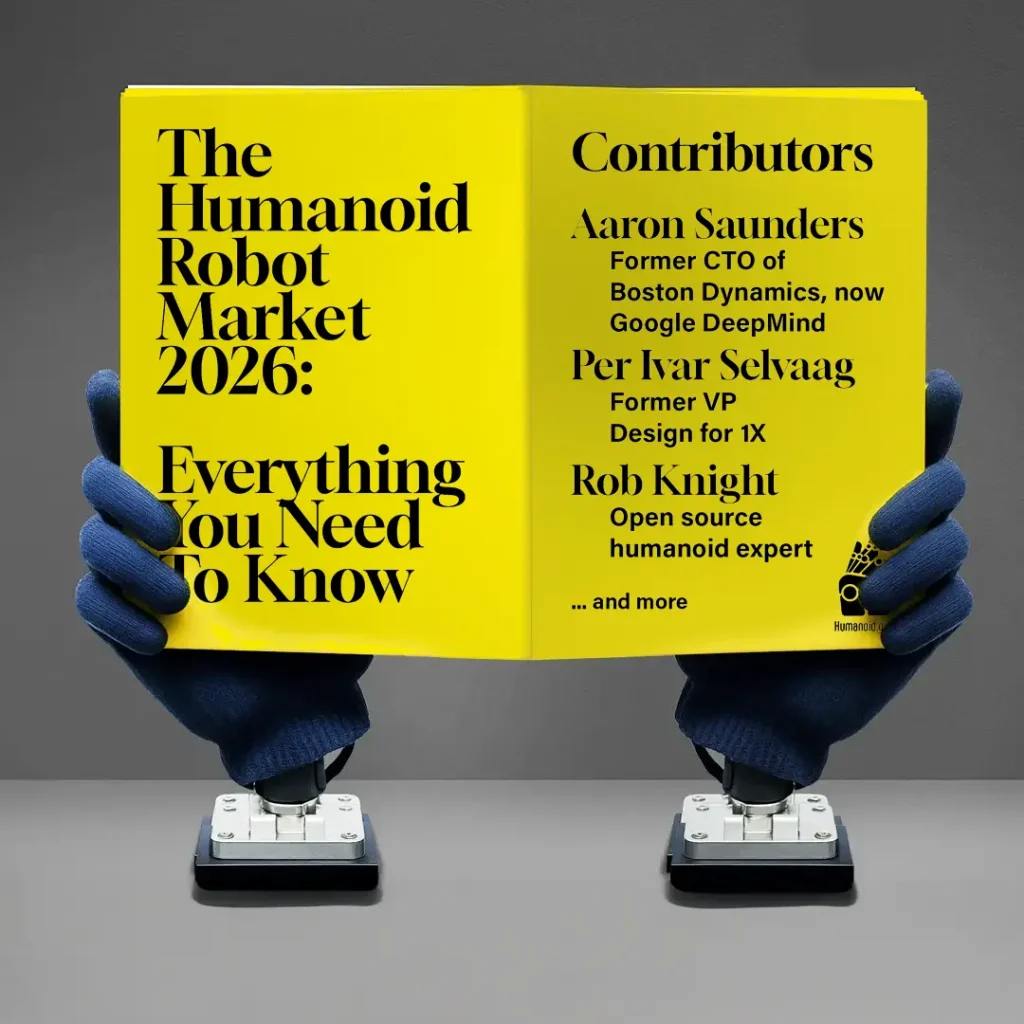
2026 Humanoid Robot Market Report
160 pages of exclusive insight from global robotics experts – uncover funding trends, technology challenges, leading manufacturers, supply chain shifts, and surveys and forecasts on future humanoid applications.

Featuring insights from
Aaron Saunders, Former CTO of
Boston Dynamics,
now Google DeepMind
2026 Humanoid Robot Market Report
160 pages of exclusive insight from global robotics experts – uncover funding trends, technology challenges, leading manufacturers, supply chain shifts, and surveys and forecasts on future humanoid applications.
According to reporting by DIGITIMES Asia, the company highlighted that humanoid robots are now transitioning from research laboratories into real world industrial settings. As this shift accelerates, questions around operational safety, human robot interaction, and regulatory alignment are moving to the forefront for manufacturers and system integrators.
Boston Dynamics indicated that trust will be a determining factor in whether humanoid systems can be deployed at scale across production environments. In practical terms, this means not only achieving reliable locomotion and manipulation, but also ensuring predictable behavior, robust fail safe mechanisms, and compliance with evolving international standards.
The article notes that international efforts to establish safety standards for humanoid and advanced industrial robots are gaining momentum in parallel with commercialization. For robotics operators and plant managers, this signals a shift from experimental pilots toward more formalized governance frameworks that define acceptable risk levels, validation procedures, and integration requirements.
For technical decision makers, the emphasis on safety blueprints suggests a maturing market. As humanoid robots begin to share workspace with human workers in manufacturing contexts, structured safety architectures and transparent certification processes are likely to become prerequisites for procurement.
Boston Dynamics’ focus reflects a broader industry trend in which competitive differentiation is expanding beyond mobility and dexterity benchmarks to include system reliability, standards compliance, and workforce acceptance. In this environment, safety engineering and trust building are emerging as core components of humanoid robot strategy rather than secondary considerations.
Source: Digitimes