Honor Debuts First Humanoid Robot at MWC 2026
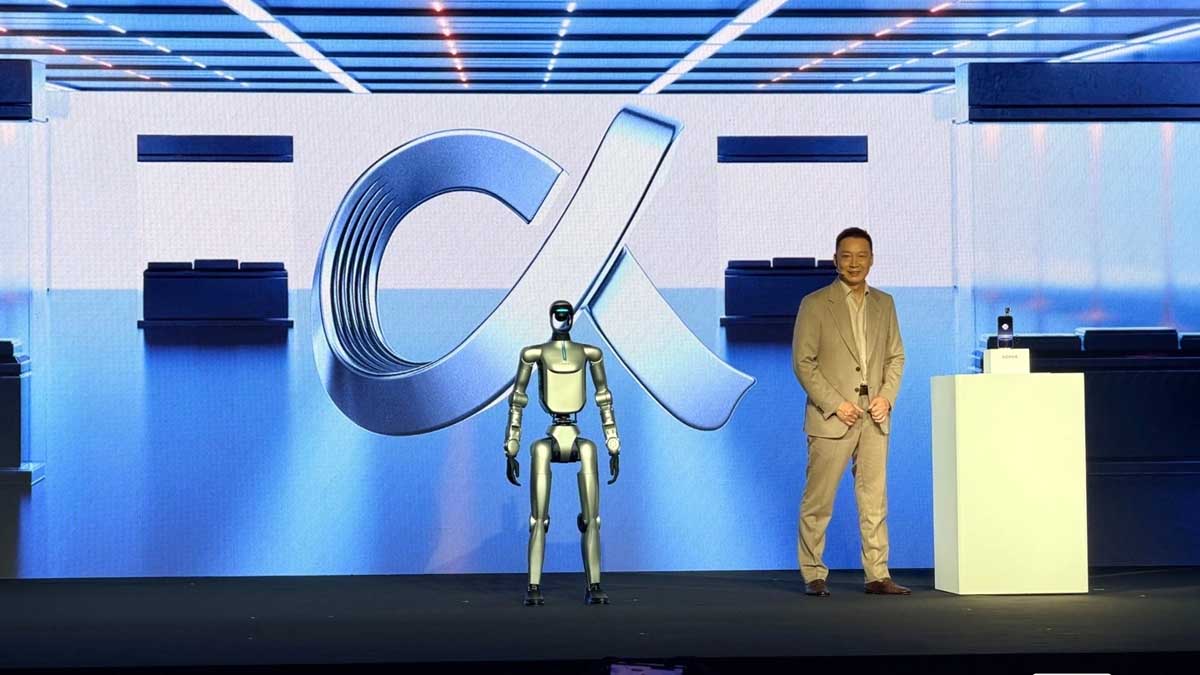
Honor has unveiled its first humanoid robot at Mobile World Congress 2026, marking the company’s formal entry into the humanoid robotics segment. The robot was presented during the company’s product showcase on March 1, where it demonstrated dynamic mobility and interactive capabilities on stage.
2026 Humanoid Robot Market Report
160 pages of exclusive insight from global robotics experts – uncover funding trends, technology challenges, leading manufacturers, supply chain shifts, and surveys and forecasts on future humanoid applications.

Featuring insights from
Aaron Saunders, Former CTO of
Boston Dynamics,
now Google DeepMind

2026 Humanoid Robot Market Report
160 pages of exclusive insight from global robotics experts – uncover funding trends, technology challenges, leading manufacturers, supply chain shifts, and surveys and forecasts on future humanoid applications.
Although Honor did not disclose detailed technical specifications, the live demonstration highlighted advanced balance and motion control. The humanoid robot performed a backflip, executed dance movements including a moonwalk, and interacted with company executives through a handshake and short exchanges. The performance emphasized whole body coordination and real time stability control, both critical benchmarks in contemporary humanoid development.
Strategic Expansion into Humanoid Robotics
Honor described the humanoid robot as part of a broader strategic move to extend its expertise in mobile technology into consumer grade robotics. The company positioned the platform as a fusion of personal intelligence and edge intelligence, designed to understand user behavior, process data locally, and protect privacy while delivering AI driven services.
This framing suggests that Honor intends to leverage its existing ecosystem of smartphones and connected devices to inform user modeling, contextual awareness, and service personalization in a humanoid form factor. Unlike traditional robotics firms that focus primarily on hardware and industrial automation, Honor indicated it will concentrate on user centric intelligence built from its consumer electronics portfolio.
Target Use Cases
According to the company, the initial focus will be on three application scenarios: shopping assistance, workplace inspections, and supportive companionship. These use cases span both commercial and semi structured environments, indicating an ambition to deploy the humanoid beyond controlled demonstration settings.
Retail assistance and shopping guidance would require robust navigation, human interaction capabilities, and integration with inventory or service platforms. Workplace inspection tasks imply mobility across varied terrain and the ability to collect or interpret environmental data. Supportive companionship points toward conversational AI, social interaction modeling, and potentially integration with smart home systems.
Mobility as a Signal of Technical Maturity
The robot’s backflip demonstration is notable in the context of humanoid benchmarking. Dynamic maneuvers of this type require precise joint actuation, high frequency feedback control, and accurate state estimation. While such demonstrations do not directly translate into industrial productivity, they serve as indicators of actuator performance, balance algorithms, and structural resilience.
No information was provided regarding degrees of freedom, actuator type, onboard compute architecture, or battery capacity. It also remains unclear whether the system is intended as a research platform, a limited pilot deployment, or a near term commercial product.
Positioning in a Growing Field
Honor’s entry into humanoid robotics reflects a broader trend of consumer electronics and technology brands exploring embodied AI platforms. By combining device ecosystem data with humanoid hardware, the company appears to be exploring differentiated value in personalization and edge processing rather than purely industrial automation.
Further technical disclosures will be necessary to assess the platform’s competitiveness in areas such as manipulation capability, endurance, safety systems, and scalable manufacturing. For now, the MWC 2026 debut positions Honor as a new participant in the humanoid robotics race, with early emphasis on mobility, interaction, and integration with its existing AI ecosystem.
Source: huaweicentral.com